
All of the work that goes into maintaining a home can feel overwhelming at times. It’s bad enough when the homeowner is at home to deal with any problems that may arise, but those headaches are only amplified while they are away on extended trips. That introduces additional concerns about minor problems that could become huge disasters if they are not dealt with promptly. A small leak, HVAC issue, or appliance failure may not be that big of a deal, but if ignored for a month, these situations could lead to major damage.
Installing the right smart home sensors can give homeowners peace of mind while they are away. Security cameras and water sensors provide them with an instant alert at the first sign of a problem, allowing them to intervene quickly. But serial creator Manivannan Sivan found himself in a situation where no off-the-shelf solutions were available that could fully ease his troubled mind. He was worried about the possibility of a failure in the boiler that heats his home. A boiler failure in the wintertime can result in burst pipes and a huge repair bill, among other problems.
Listen up!
Faced with this situation, most people would think that they have to learn to live with the uncertainty and worries of a potential heating system failure. But as an experienced machine learning developer, Sivan had a hunch that there might be a better option. As he thought about the problem, he realized that it’s possible to determine if a boiler is running by listening to the sounds it makes. Furthermore, by pairing that information with temperature measurements, one can understand if the boiler is doing its job, or if it’s in need of immediate service.
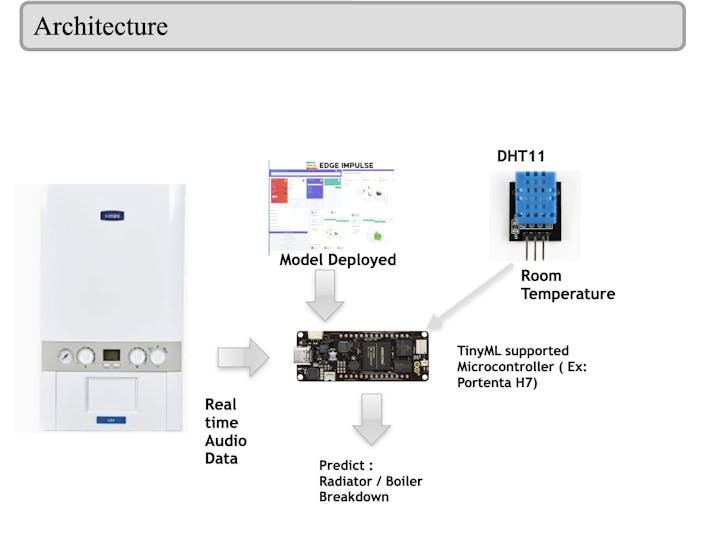
These insights were all Sivan needed to start sketching out plans for building a custom smart sensor. A machine learning classifier could easily do the job of determining if a boiler is running based on the sounds it produces. And a common, inexpensive sensor can measure the home’s temperature. Furthermore, a simple algorithm could be developed to analyze these data points to determine if the boiler has been on for an extended period of time without a corresponding rise in temperature. If so, that would indicate a boiler problem exists.
For an always-on device like this that needs to be very close to the boiler at all times, a small and energy-efficient hardware platform would be the natural choice. Sivan chose to work with the Arduino Portenta H7 development board, because it checks both of these boxes. However, this board would also need to run the machine learning model — and that could easily overwhelm its modest compute capabilities. For this reason, Sivan decided to use Edge Impulse to develop a highly optimized model that would run perfectly on the Portenta H7.
Edge AI to the rescue
With the plan fully worked out, Sivan got down to business. The first step in building the machine learning model involves collecting a dataset from which it can learn. To simplify this process, Sivan flashed the Arduino with custom Edge Impulse firmware that allows it to be linked directly to an Edge Impulse project. With help from the Edge Impulse CLI, this link was made. He then captured audio recordings from an attached microphone at times when the boiler was on, as well as when it was off.
For the prototype, a small dataset of less than two minutes of audio was collected by Sivan. This is sufficient to prove the concept, although a bit more data may be needed before using it in a real-world deployment. The Data Acquisition tool in Edge Impulse Studio automatically split this data into separate training and testing sets.

The most important (and simplest) part of the entire project was the development of the impulse. If you are new to the platform, an impulse defines how data is processed, from the time it's captured from the sensor until a prediction is made by the machine learning model. To accomplish Sivan’s goal, the impulse was designed to first preprocess incoming audio by splitting it up into chunks. An Audio MFE processing block was then used to extract time and frequency features from the signal. This serves to highlight the most informative parts of the data. The features were then fed into a classification algorithm that predicts if the boiler is on or off.
After the design was wrapped up, Sivan initiated the training process with the click of a button. Once the process was finished, metrics were displayed to help him in evaluating the model’s performance. In this case, that evaluation was quite easy — a classification accuracy of 100% was reported. In many cases, a perfect result may be suspicious; but given the clear difference in the sound of the boiler when it is on and off, this result is not unexpected.
Bringing the sensor to life
Since the impulse was performing so well, Sivan was ready to deploy it to the Portenta H7. The most flexible deployment option for this board is a downloadable Arduino library. That is the direction Sivan chose to go, because it allowed him to add in the additional logic that was needed to capture measurements from the temperature sensor and run the custom algorithm that checks for proper boiler operation. These changes can be made using the popular Arduino IDE.

In its current prototype form, the system already demonstrates that the approach is both practical and reliable. Even with a very small training dataset of less than two minutes of recorded audio, the machine learning model was able to distinguish between boiler-on and boiler-off states with 100% classification accuracy during testing. While additional data would be required to fully validate long-term performance in a wider range of operating conditions, the results clearly show that boiler acoustics provide a strong signal for dependable inference.
Equally important, the model runs comfortably on low-power, embedded hardware without requiring a constant cloud connection. Combined with temperature monitoring and simple rule-based logic, the device can detect scenarios where the boiler is operating abnormally, such as running without producing heat, early enough to trigger an alert before real damage occurs. For homeowners, this translates to a meaningful reduction in risk during extended absences.
Sivan’s project highlights an often-overlooked advantage of edge AI: when off-the-shelf products fall short, targeted machine learning models can be built quickly, deployed locally, and tuned precisely to a specific environment. With modest additional data collection and real-world testing, this system could evolve from a proof of concept into a dependable, always-on safeguard against one of the most costly failures a home can face.
Taking on the development of this type custom smart home sensor may seem like a big undertaking, but as Sivan demonstrated, you can actually build your own before a commercial device could even be shipped to your front door. And of course, you also have the option to customize everything such that it perfectly suits your unique requirements when you do it yourself.
If you need a few pointers to help you get started with your own build, you won’t want to miss reading through Sivan’s project write-up. You’ll find lots of tips to help you get your ideas off the ground.