
ImagineInnovators
Now on demand — watch the livestream and gain valuable insights at your own pace.
Why attend?

Connect
with business
Hear from embedded ML industry leaders, visionaries and researchers and participate in live discussions.
.svg)
Engage
with developers
Be at the center of the data-driven revolution and connect with like-minded developers and engineers.
Speakers
Live interviews with industry leaders and pioneers on the future of embedded machine learning.



Opening Keynote
As AI moves beyond centralized clouds, real-time intelligence at the edge is becoming essential. This keynote introduces a scalable EdgeAI platform that enables low-latency inference, secure model deployment, and seamless cloud integration across distributed environments.
We will explore architectural patterns, lifecycle management, and real-world applications that turn edge devices into autonomous decision engines. Discover how to operationalize AI closer to the data source while maintaining performance, governance, and scalability.

Ocean Water Quality Classification for Bacteria Contamination Using TinyML and Sensor Fusion
This session presents a technical overview and live demo of a TinyML project that won the Edge Impulse Hackathon 2025. The project focuses on classifying water bacteria using lightweight machine learning models deployed on resource-constrained microcontrollers.
During the session, we will walk through the project architecture, dataset, model design, and deployment pipeline using Edge Impulse and TinyML tools. Attendees will learn how the solution was built, optimized, and evaluated, as well as key lessons learned during the hackathon. The demo will show real-time inference on embedded hardware and discuss practical considerations for environmental monitoring and edge AI applications.

Quantitative Analysis of Axon-NPU Advantages in a Low‑Power Always‑On Wake Word/Keyword Spotting System
This work presents a quantitative evaluation of an Axon-NPU in an always‑on keyword spotting (KWS) pipeline targeting battery‑powered embedded systems. Our focus is audio KWS (not Visual Wake Word), and we assess how offloading compute from the CPU to the Axon NPU impacts energy consumption, inference latency, and available CPU headroom under realistic real‑time constraints.

Taking Linux Edge AI Solutions into Production
From Silicon to Deployment - Estimates are that over 70% of IoT and Edge projects fail to make it into production. We need to do better. This talk covers key considerations in designing and building devices for AI at the Edge. It covers hardware selection, software platforms and applications, production deployment, and life-cycle product management in the CRA era.

Edge AI is Transforming Robotics—or Is It the Other Way Around?
Edge AI and robotics are in a dynamic dance of innovation, each shaping the future of the other. As robots interact with the physical world—through sensors, actuators, and real-time decision-making—Edge AI is meeting the challenge by bringing intelligence closer to the sensors, where it matters most. This convergence is giving rise to Physical AI, a new field where intelligent systems don’t just process data but actively perceive, adapt, and act in real-world environments.
In this talk, we’ll cut through the noise and focus on what really matters: the tools, techniques, and trade-offs that make Physical AI possible. We’ll explore how small, optimized multimodal models—combining vision, audio, and sensor data—are essential for robots and edge devices to operate efficiently in complex, real-world settings. But to build robust systems, we also need real-world data: diverse, representative, and reflective of the environments where these models will be deployed.
Over the last year, I’ve been investigating robotic applications and recently came across the Reachy Mini robot from Hugging Face, along with its easy-to-use developer tools. I’ll show a quick example of how Edge AI techniques can be applied to such platforms, highlighting the importance of optimized models and developer-friendly tools. Whether you’re a developer, researcher, or enthusiast, this session will give you the practical insights you need to turn ideas into action.

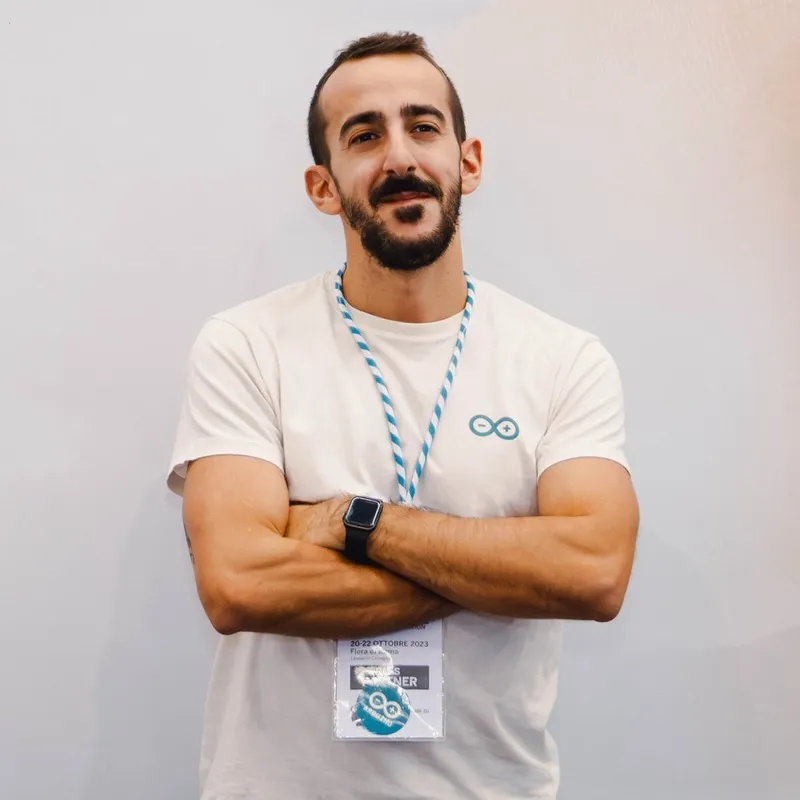
Introducing Arduino VENTUNO Q: From Blink to Physical AI
An introduction to Arduino VENTUNO Q, the next generation platform for Edge AI and Robotics, combining AI processing and real-time control on a single board. Discover how it enables Physical AI systems that can sense, decide and act in the real world.

Will it run Doom? Exploring Edge Impulse synthetic data and platform extensibility
This session will be a fun presentation and live demo of using the classic computer game, Doom, to generate a synthetic dataset and train an object detection model to detect enemies. Learn about the extensibility of Edge Impulse as well as integrating models into a final application.

AI Camera Explores Industrial AI Future
Ever since the 2022 launch of the ChatGPT 3.5 we have been bombarded by the potential of AI to improve all aspects of human endeavours this includes important segments such as logistics, production and manufacturing. Finally, we have reached a point where we can deploy highly optimised deep learning technologies at the edge and at scale for industrial applications that dramatically improve quality control, cut costs and conserve resources. Thomas Carmody, Head of Product Management and Business Development at CODICO will discuss the latest use cases and trends in these industries and how deep learning and other AI techniques on edge AI devices can significantly improve productivity and performance. He will introduce a number of cost effective, innovative solutions that leverage the flexibility and power of Qualcomm Dragonwing SoC platforms and Edge Impulse.
From Idea to Application in Minutes: Building Edge AI applications with AI Agents
In this hands-on workshop, participants will experience end-to-end Edge AI development accelerated by Claude Code with an Edge Impulse Skill.
We will start with a simple computer vision project idea and then use Claude Code + the Edge Impulse Skill to generate an application where we will be able to deploy ML models and run live inference on the board (Arduino UNO Q or similar).
This session highlights how developer tooling innovations (AI agents + domain-specific Skills) bridge imagination and implementation, making Edge AI approachable for developers, educators, and professionals.

From Camera to Insight: Building Production-Ready Vision AI with Advantech iCAM-300 and Edge Impulse
Vision AI promises a lot, but shipping it end-to-end is where things get real. In this session, Advantech engineers walk through what it actually takes to go from raw camera data to a deployed, production-grade intelligent vision solution using the iCAM-300 series.
You’ll get a look at concrete use cases, from industrial inspection to smart environments, showing where vision AI delivers genuine operational value and what drives those decisions at the system level. Then we go deeper: an architectural breakdown of the full solution stack, from sensor and hardware constraints to model design, inference runtime, and operational integration. Along the way, we’ll call out the decisions that matter most, the tradeoffs, the failure modes, and the things that separate a working demo from a system that holds up in the field.
Running through it all is Edge Impulse, covering how the platform bridges the gap between messy real-world data and models that actually perform, accelerating the path from dataset to deployed insight without requiring a team of ML researchers.
Whether you’re just starting to evaluate intelligent camera solutions or already deep in a deployment, you’ll leave with a clearer mental model of what a well-architected vision AI system looks like, and more importantly a concrete sense of how to build one.
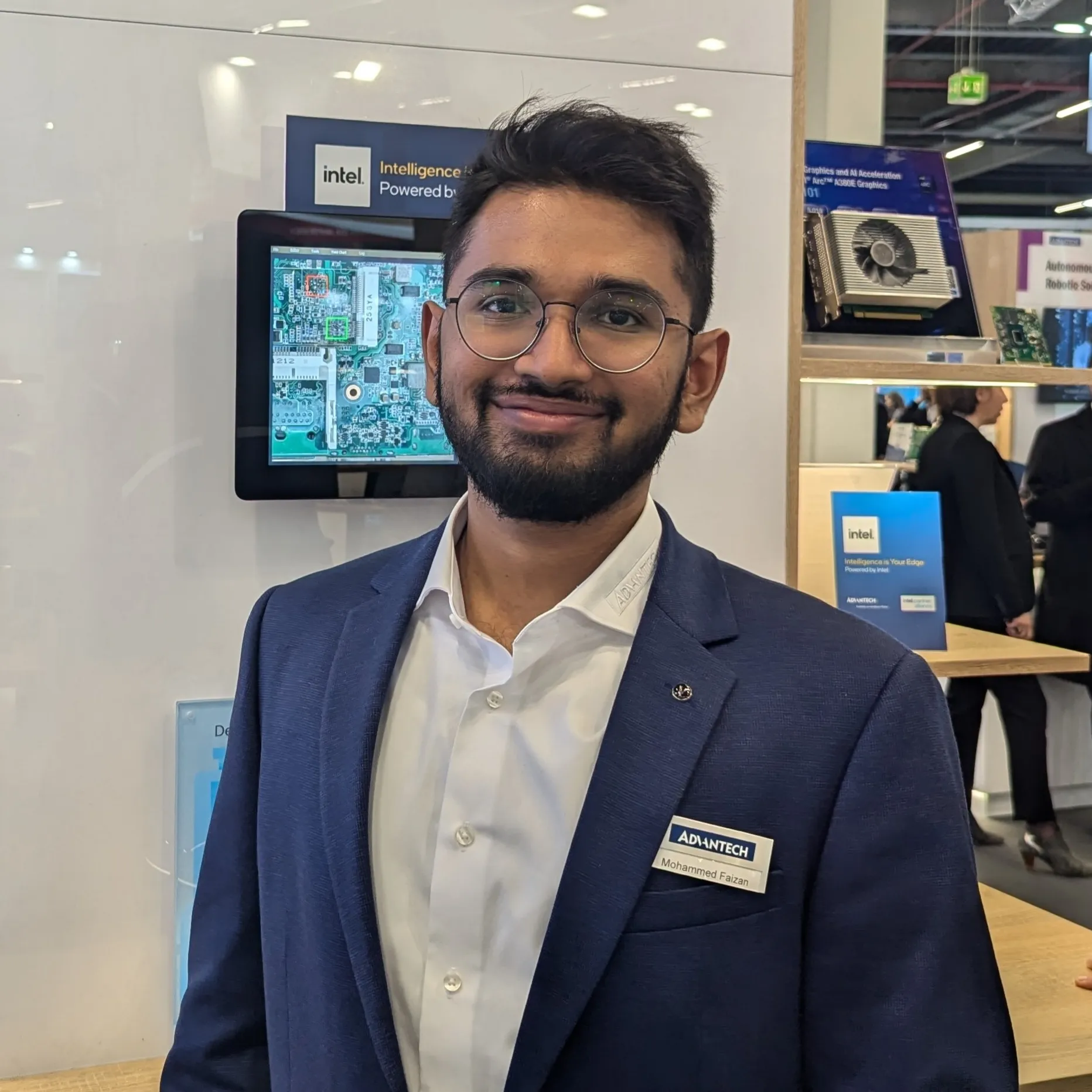
Fast-Track Edge AI for Solution Builder
Rapidly build, optimize, and deploy edge AI on Advantech platforms using Edge Impulse, simplifying workflows and accelerating the path from PoC to production.

Making Physical AI Work: Bridging Business Goals and Edge AI
Physical AI is quickly moving beyond small pilot projects and into real-world use across industries like manufacturing, logistics, mobility, and healthcare. At the same time, edge AI has become a reliable way to deploy models directly on or near devices, enabling faster response times, stronger data privacy, and less reliance on constant cloud connectivity.
Still, many efforts struggle to get off the ground. Often, they begin with the technology itself instead of a clear business goal, or they overlook the unique constraints that come with edge environments. This session offers a practical approach to bridging that gap, showing how to connect business objectives with technical design so that physical and edge AI deliver real, measurable impact, not just standalone proofs of concept.

Beyond TOPS: System-Level Compute Efficiency with the Axon NPU and DSP Integration for Low-Cost Edge AI
This talk makes the case for choosing AI accelerators based on end‑to‑end efficiency rather than peak TOPS, quantifying how the Axon NPU, tightly integrated with a lean DSP, lowers energy, latency, and system cost for on‑device inference.

Bringing Edge Impulse to ROS: Building an Edge-AI-Powered Inspection Robot
Robotics applications increasingly require reliable, low-latency intelligence deployed directly at the edge. As ROS continues to be the foundation for modern robotic systems, tighter integration between ROS workflows and Edge AI development platforms is essential for accelerating real-world deployments.
In this talk, we present Bringing Edge Impulse to ROS, a new ROS-based integration that enables developers to run Edge Impulse models natively within ROS nodes. This work extends the Edge Impulse ecosystem into robotics, allowing teams to deploy, manage, and optimise edge machine learning models as first-class components of ROS-based systems.
We demonstrate this integration through an autonomous pipe inspection robot performing real-time anomaly detection on industrial pipelines. Building on a corrosion detection use case previously showcased at GITEX, the system uses an Edge Impulse–trained anomaly detection model to identify corrosion and surface defects on oil and gas pipelines. The robot automates this inspection process, running fully on-device with low latency and offline operation.
The session covers system architecture, ROS integration patterns, model optimisation for embedded hardware, and practical lessons learned from deploying Edge AI in a robotic inspection workflow. Attendees will gain concrete guidance on combining Edge Impulse and ROS to build scalable, intelligent robotic systems for industrial and autonomous applications.

Trust the Data, Then the Model
Machine learning performance is bounded by the quality of its data. Many failures can be traced back to issues such as noisy labels, unrepresentative test data and biased sampling rather than the choice of model. This talk will detail some of the tools that are in Edge Impulse and others that we are working on that can help users find problems in their data and fix them in order to optimize performance. Including a deep dive into how some of the data quality algorithms we use work.

Shaping the Next Wave of Edge AI: Edge Impulse Power User Roundtable
Join members of the Edge Impulse product team in a discussion-based roundtable to discuss recent releases, what’s coming on our roadmap, and to share your feedback on the platform.
This session is designed for Edge Impulse power users and experienced developers who want to share candid insights on workflows, opportunities, and their experience with the platform.
Note: Space for this session is very limited. Formal invites will be sent to specific attendees who meet the criteria for this session.

Designing Robust Sensor Fusion Architectures for Real-World Edge AI
Sensor fusion can dramatically improve accuracy and reliability in Edge AI systems, but it also multiplies computational complexity. How do we combine multiple sensor modalities without exceeding power, memory, and latency constraints?
This breakout session presents a systematic approach to building efficient multimodal models for microcontrollers and embedded processors. We explore architectural patterns for fusing time-series, acoustic, and environmental data streams while minimizing memory usage and compute overhead. The session includes comparisons between concatenated feature vectors, lightweight ensemble fusion, and attention-inspired adaptive weighting techniques optimized for quantized deployment.
Attendees will walk away with a clear framework for designing sensor fusion systems that are both robust and efficient, enabling smarter devices without sacrificing battery life or responsiveness.

Lazy Learning for the Factory Floor
From Zero-Shot to Production (Without the Data Collection Nightmare)
Training object detection models for industrial inspection typically means collecting thousands of images, spending weeks annotating, and praying your factory doesn't introduce a new component next month. We needed to quickly train a system to inspect new components in a product where each component could be one of thousands of options, so pre-training a library was not an option.
At Consult Red, we took a "lazier" approach. By leveraging the invariant nature of fixed inspection jigs and controlled lighting, we’ve moved from asking "Is there a terminal block here?" to verifying "Is X1 specifically where it is supposed to be?". We take advantage of the constraints in the system to learn only what is needed and use this to speed training and allow rapid inference for the many components in a new product. Using a two-stage approach, an open-vocabulary model for generalised zero-shot identification and a fine-tuned YOLO Pro for specific component identification, and using the natural stages of assembly as training checkpoints, we can make the model training a quick and painless part of that process.
EchoGlow: Build a voice-controlled smart light with Arduino UNO Q and Edge Impulse
In this hands-on workshop, you will design and build your own EchoGlow, a smart lighting system that reacts to your voice commands and changes the colors.
During this session you will collect audio and sensor data, train an AI model with Edge Impulse, assemble a custom LED and microphone boards with an enclosure around the Arduino UNO Q. Finally you will deploy the model directly for on-device inference.
This workshop combines hardware assembly, model training, and deployment giving you hands-on end-to-end experience with modern EdgeAI development.
Join us together with Arduino, Edge Impulse and Supplyframe DesignLab for this hands-on workshop. This is perfect for developers, makers and engineers who want to go beyond theory and create something tangible with the latest edgeAI technologies.
Due to limited availability, we can only provide 30 complete kits on a first-come, first-served basis for those who signed up.
If the workshop is fully booked on the website, we recommend arriving at the door and any registered participants who do not show up on time will lose their kit, which will then be offered to people in the waiting line.

Enabling Always-On, Battery-First Edge AI with BrainChip’s AkidaTag
This session presents BrainChip’s AkidaTag, a purpose-built platform designed to bring ultra-low power, always-on intelligence to real-world edge devices. Built on the neuromorphic Akida architecture, AkidaTag demonstrates how event-based AI can overcome the traditional “battery wall” that limits continuous sensing applications.Unlike conventional edge AI systems that rely on periodic inference or cloud connectivity, AkidaTag enables continuous, real-time processing directly on-device at milliwatt-scale power. Its event-driven design processes only meaningful data, dramatically reducing compute and energy requirements while maintaining responsiveness and accuracy.
This talk will showcase how AkidaTag supports three critical capabilities for next-generation edge applications:
- Always-on operation with multi-day battery life for continuous sensing
- Privacy-first AI, with all data processed locally and no cloud dependency
- On-device learning, enabling personalization to individual users without retraining pipelines
Through live demonstrations and workflows built with Edge Impulse, attendees will see how developers can rapidly build and deploy models for use cases such as wearable health monitoring, industrial anomaly detection, and intelligent audio interfaces all running entirely at the edge.
By focusing on a complete reference platform rather than just silicon, this session highlights how AkidaTag bridges the gap between cutting-edge neuromorphic AI and deployable products. Attendees will leave with a practical understanding of how to develop new use cases on AkidaTag from prototype to production.

From Python and Webcams to Robotics: A Practical Teaching Pipeline for Edge AI with Edge Impulse
Many Edge AI learning workflows begin directly on constrained hardware, which can create unnecessary barriers for beginners. In our Information Technology course for engineering students, we instead introduce Edge AI using Python, standard computers, and webcams together with Edge Impulse
Students collect datasets, train vision models, and build real-time inference pipelines before connecting model outputs to robotic systems. This staged approach allows them to create meaningful AI-driven applications early in the learning process without requiring embedded-systems experience.
The session presents this teaching workflow and shares lessons learned from introducing Edge AI to multidisciplinary engineering students using accessible tools that scale naturally toward later deployment on embedded platforms and autonomous systems.
.webp)
Building the Platform for Physical Agentic AI
After taking over the Internet, AI agents are jumping to the physical world. This brings huge opportunities—and massive challenges, too.
Physical Agentic AI is a brand new field of engineering, where the fuzzy reasoning of language models meets the hard reality of sensory perception and physical constraints. It lets us place a spark of human insight into every object we make. But how do we frame problems, measure performance, and prove that we’re building effective physical AI?
In this talk, by the founding engineer at Edge Impulse and author of TinyML and AI at the Edge, we’ll explore this new frontier and learn how we’ll need to rethink our developer tools to help AI agents solve problems in physical space.

Deep Dive into Edge Impulse Inferencing SDK
Step through main stages of inferencing pipeline for common models, exposing main components of the SDK and explaining them.

Quectel Pi + Edge Impulse Capabilities
Quectel Pi enables rapid development and deployment of intelligent edge AI solutions by combining high-performance Smart IoT hardware with a developer-friendly ecosystem. When integrated with Edge Impulse, Quectel Pi allows engineers to easily collect data, train machine learning models, and deploy optimized inference directly at the edge. This approach reduces latency, enhances data privacy, and lowers cloud dependency. With support for computer vision, audio, and sensor-based AI use cases, Quectel Pi accelerates prototyping and streamlines the transition from proof of concept to production, empowering scalable, energy-efficient, and real-time IoT intelligence.

From Code to Context: Ensuring Your Edge AI Applications Succeed in the Field
As a developer, there is no greater professional satisfaction than seeing the application you’ve built move out of the lab and solve a real-world problem. However, the path to success is often blocked by the "prototype trap", where software that performs perfectly on a dev kit fails to scale due to hardware limitations, thermal throttling, or environmental instability. To realize the full value of your innovation, you need a deployment strategy that honors the complexity of your code.
In this session, we draw on OnLogic’s expertise in industrial computing to outline a framework for selecting the right hardware to support your AI vision. Using the OnLogic FR101 (which comes with out-of-the-box Edge Impulse support) as a practical example, we will discuss how to move past the bench and into the field.
Key discussion points will include:
- The Antidote to Overkill: Why more power isn't always better, and how to right-size your CPU, GPU, or NPU requirements based on real-world benchmark data.
- Hardware-First Prototyping: The importance of selecting production-ready hardware during development to avoid costly redesigns, thermal issues, and performance bottlenecks.
- The Industrial Reality: How environmental factors like wide-temperature ranges and vibration impact the long-term reliability of Edge AI models in the wild.
- Streamlined Integration: Leveraging the partnership between OnLogic and Edge Impulse to accelerate the journey from data collection to a deployed, scalable solution.
Attendees will leave with a clear methodology for right-sizing their hardware, ensuring their Edge AI projects are not just possible, but ready for the rigors of industrial scale

Charting the Course: Navigating Maritime VHF Communications Using Edge Impulse
In this talk, I will demonstrate how the Edge Impulse platform can be used to create agentic AI workflows and generate synthetic data using foundation models. I will also present an appealing use case for running LLMs at the edge on-device.
The application I will present is inspired by my experience of learning to sail a yacht at sea. It helps to interpret maritime VHF voice communications and alerts lazy sailors when an important message has been received, such as a 'mayday' message.

A Perforated Classification Block for Fewer Errors and Smaller Models
In this session, we’re bridging the gap between modern neuroscience and edge AI. Replacing your NN Classifier block with the Perforated Classification Block can immediately reduce your error rate by up to 70%, or enable you to maintain the same accuracy with models up to 90% smaller.
We’ll kick things off with a live, hands-on walkthrough. You'll learn exactly how to snap this block into your own Edge Impulse projects and see immediate benefits. Next, we’ll dive into the breakthroughs behind the block. Learn how modern neuroscience has uncovered the previously unseen way that biological dendritic branches drive decision-making, and see how we translated those organic principles into artificial dendrites for neural nets, the first fundamental upgrade to the artificial neuron in decades. Finally, we'll walk you through our hackathon-winning project, reveal our experimental results, and give you everything you need to get started today.
If you're using the neural network classifier block in your project, this session was built for you.
(Requirements for walkthrough: Edge Impulse and GitHub accounts)

Vision is Overrated: The Case for Sensor Fusion in Robotics
Robotic systems increasingly default to vision-based AI, even for tasks that are dominated by physical interaction and environmental context rather than appearance. This talk argues that many robotic intelligence problems are better addressed through sensor fusion at the edge, by combining multiple simple, low-cost sensors instead of relying on cameras alone.
Using ROS and Edge Impulse, the presentation introduces a practical workflow for collecting, training, and deploying sensor fusion models directly on robotic systems. By fusing signals such as IMU data, motor feedback, acoustic cues, and other lightweight sensors, robots can infer state, interaction, and intent in ways that are often more robust and efficient than vision-based approaches.
The presentation focuses on a practical ROS-to-edge-AI workflow built around Edge Impulse, showing how ROS topics can be directly leveraged for data collection, model training, and deployment of lightweight machine learning models. Rather than treating non-visual signals as secondary inputs, this approach elevates them to first-class citizens for learning and inference at the edge.
Introducing Arduino VENTUNO Q: From Blink to Physical AI
An introduction to Arduino VENTUNO Q, the next generation platform for Edge AI and Robotics, combining AI processing and real-time control on a single board. Discover how it enables Physical AI systems that can sense, decide and act in the real world.
From Camera to Insight: Building Production-Ready Vision AI with Advantech iCAM-300 and Edge Impulse
Vision AI promises a lot, but shipping it end-to-end is where things get real. In this session, Advantech engineers walk through what it actually takes to go from raw camera data to a deployed, production-grade intelligent vision solution using the iCAM-300 series.
You’ll get a look at concrete use cases, from industrial inspection to smart environments, showing where vision AI delivers genuine operational value and what drives those decisions at the system level. Then we go deeper: an architectural breakdown of the full solution stack, from sensor and hardware constraints to model design, inference runtime, and operational integration. Along the way, we’ll call out the decisions that matter most, the tradeoffs, the failure modes, and the things that separate a working demo from a system that holds up in the field.
Running through it all is Edge Impulse, covering how the platform bridges the gap between messy real-world data and models that actually perform, accelerating the path from dataset to deployed insight without requiring a team of ML researchers.
Whether you’re just starting to evaluate intelligent camera solutions or already deep in a deployment, you’ll leave with a clearer mental model of what a well-architected vision AI system looks like, and more importantly a concrete sense of how to build one.
EchoGlow: Build a voice-controlled smart light with Arduino UNO Q and Edge Impulse
In this hands-on workshop, you will design and build your own EchoGlow, a smart lighting system that reacts to your voice commands and changes the colors.
During this session you will collect audio and sensor data, train an AI model with Edge Impulse, assemble a custom LED and microphone boards with an enclosure around the Arduino UNO Q. Finally you will deploy the model directly for on-device inference.
This workshop combines hardware assembly, model training, and deployment giving you hands-on end-to-end experience with modern EdgeAI development.
Join us together with Arduino, Edge Impulse and Supplyframe DesignLab for this hands-on workshop. This is perfect for developers, makers and engineers who want to go beyond theory and create something tangible with the latest edgeAI technologies.
Due to limited availability, we can only provide 30 complete kits on a first-come, first-served basis for those who signed up.
If the workshop is fully booked on the website, we recommend arriving at the door and any registered participants who do not show up on time will lose their kit, which will then be offered to people in the waiting line.
Shaping the Next Wave of Edge AI: Edge Impulse Power User Roundtable
Join members of the Edge Impulse product team in a discussion-based roundtable to discuss recent releases, what’s coming on our roadmap, and to share your feedback on the platform.
This session is designed for Edge Impulse power users and experienced developers who want to share candid insights on workflows, opportunities, and their experience with the platform.
Note: Space for this session is very limited. Formal invites will be sent to specific attendees who meet the criteria for this session.
From Python and Webcams to Robotics: A Practical Teaching Pipeline for Edge AI with Edge Impulse
Many Edge AI learning workflows begin directly on constrained hardware, which can create unnecessary barriers for beginners. In our Information Technology course for engineering students, we instead introduce Edge AI using Python, standard computers, and webcams together with Edge Impulse
Students collect datasets, train vision models, and build real-time inference pipelines before connecting model outputs to robotic systems. This staged approach allows them to create meaningful AI-driven applications early in the learning process without requiring embedded-systems experience.
The session presents this teaching workflow and shares lessons learned from introducing Edge AI to multidisciplinary engineering students using accessible tools that scale naturally toward later deployment on embedded platforms and autonomous systems.
Enabling Always-On, Battery-First Edge AI with BrainChip’s AkidaTag
This session presents BrainChip’s AkidaTag, a purpose-built platform designed to bring ultra-low power, always-on intelligence to real-world edge devices. Built on the neuromorphic Akida architecture, AkidaTag demonstrates how event-based AI can overcome the traditional “battery wall” that limits continuous sensing applications.Unlike conventional edge AI systems that rely on periodic inference or cloud connectivity, AkidaTag enables continuous, real-time processing directly on-device at milliwatt-scale power. Its event-driven design processes only meaningful data, dramatically reducing compute and energy requirements while maintaining responsiveness and accuracy.
This talk will showcase how AkidaTag supports three critical capabilities for next-generation edge applications:
- Always-on operation with multi-day battery life for continuous sensing
- Privacy-first AI, with all data processed locally and no cloud dependency
- On-device learning, enabling personalization to individual users without retraining pipelines
Through live demonstrations and workflows built with Edge Impulse, attendees will see how developers can rapidly build and deploy models for use cases such as wearable health monitoring, industrial anomaly detection, and intelligent audio interfaces all running entirely at the edge.
By focusing on a complete reference platform rather than just silicon, this session highlights how AkidaTag bridges the gap between cutting-edge neuromorphic AI and deployable products. Attendees will leave with a practical understanding of how to develop new use cases on AkidaTag from prototype to production.
From Code to Context: Ensuring Your Edge AI Applications Succeed in the Field
As a developer, there is no greater professional satisfaction than seeing the application you’ve built move out of the lab and solve a real-world problem. However, the path to success is often blocked by the "prototype trap", where software that performs perfectly on a dev kit fails to scale due to hardware limitations, thermal throttling, or environmental instability. To realize the full value of your innovation, you need a deployment strategy that honors the complexity of your code.
In this session, we draw on OnLogic’s expertise in industrial computing to outline a framework for selecting the right hardware to support your AI vision. Using the OnLogic FR101 (which comes with out-of-the-box Edge Impulse support) as a practical example, we will discuss how to move past the bench and into the field.
Key discussion points will include:
- The Antidote to Overkill: Why more power isn't always better, and how to right-size your CPU, GPU, or NPU requirements based on real-world benchmark data.
- Hardware-First Prototyping: The importance of selecting production-ready hardware during development to avoid costly redesigns, thermal issues, and performance bottlenecks.
- The Industrial Reality: How environmental factors like wide-temperature ranges and vibration impact the long-term reliability of Edge AI models in the wild.
- Streamlined Integration: Leveraging the partnership between OnLogic and Edge Impulse to accelerate the journey from data collection to a deployed, scalable solution.
Attendees will leave with a clear methodology for right-sizing their hardware, ensuring their Edge AI projects are not just possible, but ready for the rigors of industrial scale
Making Physical AI Work: Bridging Business Goals and Edge AI
Physical AI is quickly moving beyond small pilot projects and into real-world use across industries like manufacturing, logistics, mobility, and healthcare. At the same time, edge AI has become a reliable way to deploy models directly on or near devices, enabling faster response times, stronger data privacy, and less reliance on constant cloud connectivity.
Still, many efforts struggle to get off the ground. Often, they begin with the technology itself instead of a clear business goal, or they overlook the unique constraints that come with edge environments. This session offers a practical approach to bridging that gap, showing how to connect business objectives with technical design so that physical and edge AI deliver real, measurable impact, not just standalone proofs of concept.
Taking Linux Edge AI Solutions into Production
From Silicon to Deployment - Estimates are that over 70% of IoT and Edge projects fail to make it into production. We need to do better. This talk covers key considerations in designing and building devices for AI at the Edge. It covers hardware selection, software platforms and applications, production deployment, and life-cycle product management in the CRA era.
Drinks Reception
Celebrate an amazing day!
Vision is Overrated: The Case for Sensor Fusion in Robotics
Robotic systems increasingly default to vision-based AI, even for tasks that are dominated by physical interaction and environmental context rather than appearance. This talk argues that many robotic intelligence problems are better addressed through sensor fusion at the edge, by combining multiple simple, low-cost sensors instead of relying on cameras alone.
Using ROS and Edge Impulse, the presentation introduces a practical workflow for collecting, training, and deploying sensor fusion models directly on robotic systems. By fusing signals such as IMU data, motor feedback, acoustic cues, and other lightweight sensors, robots can infer state, interaction, and intent in ways that are often more robust and efficient than vision-based approaches.
The presentation focuses on a practical ROS-to-edge-AI workflow built around Edge Impulse, showing how ROS topics can be directly leveraged for data collection, model training, and deployment of lightweight machine learning models. Rather than treating non-visual signals as secondary inputs, this approach elevates them to first-class citizens for learning and inference at the edge.
A Perforated Classification Block for Fewer Errors and Smaller Models
In this session, we’re bridging the gap between modern neuroscience and edge AI. Replacing your NN Classifier block with the Perforated Classification Block can immediately reduce your error rate by up to 70%, or enable you to maintain the same accuracy with models up to 90% smaller.
We’ll kick things off with a live, hands-on walkthrough. You'll learn exactly how to snap this block into your own Edge Impulse projects and see immediate benefits. Next, we’ll dive into the breakthroughs behind the block. Learn how modern neuroscience has uncovered the previously unseen way that biological dendritic branches drive decision-making, and see how we translated those organic principles into artificial dendrites for neural nets, the first fundamental upgrade to the artificial neuron in decades. Finally, we'll walk you through our hackathon-winning project, reveal our experimental results, and give you everything you need to get started today.
If you're using the neural network classifier block in your project, this session was built for you.
(Requirements for walkthrough: Edge Impulse and GitHub accounts)
Charting the Course: Navigating Maritime VHF Communications Using Edge Impulse
In this talk, I will demonstrate how the Edge Impulse platform can be used to create agentic AI workflows and generate synthetic data using foundation models. I will also present an appealing use case for running LLMs at the edge on-device.
The application I will present is inspired by my experience of learning to sail a yacht at sea. It helps to interpret maritime VHF voice communications and alerts lazy sailors when an important message has been received, such as a 'mayday' message.
Quectel Pi + Edge Impulse Capabilities
Quectel Pi enables rapid development and deployment of intelligent edge AI solutions by combining high-performance Smart IoT hardware with a developer-friendly ecosystem. When integrated with Edge Impulse, Quectel Pi allows engineers to easily collect data, train machine learning models, and deploy optimized inference directly at the edge. This approach reduces latency, enhances data privacy, and lowers cloud dependency. With support for computer vision, audio, and sensor-based AI use cases, Quectel Pi accelerates prototyping and streamlines the transition from proof of concept to production, empowering scalable, energy-efficient, and real-time IoT intelligence.
Deep Dive into Edge Impulse Inferencing SDK
Step through main stages of inferencing pipeline for common models, exposing main components of the SDK and explaining them.
Building the Platform for Physical Agentic AI
After taking over the Internet, AI agents are jumping to the physical world. This brings huge opportunities—and massive challenges, too.
Physical Agentic AI is a brand new field of engineering, where the fuzzy reasoning of language models meets the hard reality of sensory perception and physical constraints. It lets us place a spark of human insight into every object we make. But how do we frame problems, measure performance, and prove that we’re building effective physical AI?
In this talk, by the founding engineer at Edge Impulse and author of TinyML and AI at the Edge, we’ll explore this new frontier and learn how we’ll need to rethink our developer tools to help AI agents solve problems in physical space.
Trust the Data, Then the Model
Machine learning performance is bounded by the quality of its data. Many failures can be traced back to issues such as noisy labels, unrepresentative test data and biased sampling rather than the choice of model. This talk will detail some of the tools that are in Edge Impulse and others that we are working on that can help users find problems in their data and fix them in order to optimize performance. Including a deep dive into how some of the data quality algorithms we use work.
Lazy Learning for the Factory Floor
From Zero-Shot to Production (Without the Data Collection Nightmare)
Training object detection models for industrial inspection typically means collecting thousands of images, spending weeks annotating, and praying your factory doesn't introduce a new component next month. We needed to quickly train a system to inspect new components in a product where each component could be one of thousands of options, so pre-training a library was not an option.
At Consult Red, we took a "lazier" approach. By leveraging the invariant nature of fixed inspection jigs and controlled lighting, we’ve moved from asking "Is there a terminal block here?" to verifying "Is X1 specifically where it is supposed to be?". We take advantage of the constraints in the system to learn only what is needed and use this to speed training and allow rapid inference for the many components in a new product. Using a two-stage approach, an open-vocabulary model for generalised zero-shot identification and a fine-tuned YOLO Pro for specific component identification, and using the natural stages of assembly as training checkpoints, we can make the model training a quick and painless part of that process.
Designing Robust Sensor Fusion Architectures for Real-World Edge AI
Sensor fusion can dramatically improve accuracy and reliability in Edge AI systems, but it also multiplies computational complexity. How do we combine multiple sensor modalities without exceeding power, memory, and latency constraints?
This breakout session presents a systematic approach to building efficient multimodal models for microcontrollers and embedded processors. We explore architectural patterns for fusing time-series, acoustic, and environmental data streams while minimizing memory usage and compute overhead. The session includes comparisons between concatenated feature vectors, lightweight ensemble fusion, and attention-inspired adaptive weighting techniques optimized for quantized deployment.
Attendees will walk away with a clear framework for designing sensor fusion systems that are both robust and efficient, enabling smarter devices without sacrificing battery life or responsiveness.
Bringing Edge Impulse to ROS: Building an Edge-AI-Powered Inspection Robot
Robotics applications increasingly require reliable, low-latency intelligence deployed directly at the edge. As ROS continues to be the foundation for modern robotic systems, tighter integration between ROS workflows and Edge AI development platforms is essential for accelerating real-world deployments.
In this talk, we present Bringing Edge Impulse to ROS, a new ROS-based integration that enables developers to run Edge Impulse models natively within ROS nodes. This work extends the Edge Impulse ecosystem into robotics, allowing teams to deploy, manage, and optimise edge machine learning models as first-class components of ROS-based systems.
We demonstrate this integration through an autonomous pipe inspection robot performing real-time anomaly detection on industrial pipelines. Building on a corrosion detection use case previously showcased at GITEX, the system uses an Edge Impulse–trained anomaly detection model to identify corrosion and surface defects on oil and gas pipelines. The robot automates this inspection process, running fully on-device with low latency and offline operation.
The session covers system architecture, ROS integration patterns, model optimisation for embedded hardware, and practical lessons learned from deploying Edge AI in a robotic inspection workflow. Attendees will gain concrete guidance on combining Edge Impulse and ROS to build scalable, intelligent robotic systems for industrial and autonomous applications.
Beyond TOPS: System-Level Compute Efficiency with the Axon NPU and DSP Integration for Low-Cost Edge AI
This talk makes the case for choosing AI accelerators based on end‑to‑end efficiency rather than peak TOPS, quantifying how the Axon NPU, tightly integrated with a lean DSP, lowers energy, latency, and system cost for on‑device inference.
Lunch
Fast-Track Edge AI for Solution Builder
Rapidly build, optimize, and deploy edge AI on Advantech platforms using Edge Impulse, simplifying workflows and accelerating the path from PoC to production.
From Idea to Application in Minutes: Building Edge AI applications with AI Agents
In this hands-on workshop, participants will experience end-to-end Edge AI development accelerated by Claude Code with an Edge Impulse Skill.
We will start with a simple computer vision project idea and then use Claude Code + the Edge Impulse Skill to generate an application where we will be able to deploy ML models and run live inference on the board (Arduino UNO Q or similar).
This session highlights how developer tooling innovations (AI agents + domain-specific Skills) bridge imagination and implementation, making Edge AI approachable for developers, educators, and professionals.
AI Camera Explores Industrial AI Future
Ever since the 2022 launch of the ChatGPT 3.5 we have been bombarded by the potential of AI to improve all aspects of human endeavours this includes important segments such as logistics, production and manufacturing. Finally, we have reached a point where we can deploy highly optimised deep learning technologies at the edge and at scale for industrial applications that dramatically improve quality control, cut costs and conserve resources. Thomas Carmody, Head of Product Management and Business Development at CODICO will discuss the latest use cases and trends in these industries and how deep learning and other AI techniques on edge AI devices can significantly improve productivity and performance. He will introduce a number of cost effective, innovative solutions that leverage the flexibility and power of Qualcomm Dragonwing SoC platforms and Edge Impulse.
Will it run Doom? Exploring Edge Impulse synthetic data and platform extensibility
This session will be a fun presentation and live demo of using the classic computer game, Doom, to generate a synthetic dataset and train an object detection model to detect enemies. Learn about the extensibility of Edge Impulse as well as integrating models into a final application.
Edge AI is Transforming Robotics—or Is It the Other Way Around?
Edge AI and robotics are in a dynamic dance of innovation, each shaping the future of the other. As robots interact with the physical world—through sensors, actuators, and real-time decision-making—Edge AI is meeting the challenge by bringing intelligence closer to the sensors, where it matters most. This convergence is giving rise to Physical AI, a new field where intelligent systems don’t just process data but actively perceive, adapt, and act in real-world environments.
In this talk, we’ll cut through the noise and focus on what really matters: the tools, techniques, and trade-offs that make Physical AI possible. We’ll explore how small, optimized multimodal models—combining vision, audio, and sensor data—are essential for robots and edge devices to operate efficiently in complex, real-world settings. But to build robust systems, we also need real-world data: diverse, representative, and reflective of the environments where these models will be deployed.
Over the last year, I’ve been investigating robotic applications and recently came across the Reachy Mini robot from Hugging Face, along with its easy-to-use developer tools. I’ll show a quick example of how Edge AI techniques can be applied to such platforms, highlighting the importance of optimized models and developer-friendly tools. Whether you’re a developer, researcher, or enthusiast, this session will give you the practical insights you need to turn ideas into action.
Quantitative Analysis of Axon-NPU Advantages in a Low‑Power Always‑On Wake Word/Keyword Spotting System
This work presents a quantitative evaluation of an Axon-NPU in an always‑on keyword spotting (KWS) pipeline targeting battery‑powered embedded systems. Our focus is audio KWS (not Visual Wake Word), and we assess how offloading compute from the CPU to the Axon NPU impacts energy consumption, inference latency, and available CPU headroom under realistic real‑time constraints.
Ocean Water Quality Classification for Bacteria Contamination Using TinyML and Sensor Fusion
This session presents a technical overview and live demo of a TinyML project that won the Edge Impulse Hackathon 2025. The project focuses on classifying water bacteria using lightweight machine learning models deployed on resource-constrained microcontrollers.
During the session, we will walk through the project architecture, dataset, model design, and deployment pipeline using Edge Impulse and TinyML tools. Attendees will learn how the solution was built, optimized, and evaluated, as well as key lessons learned during the hackathon. The demo will show real-time inference on embedded hardware and discuss practical considerations for environmental monitoring and edge AI applications.
Opening Keynote
As AI moves beyond centralized clouds, real-time intelligence at the edge is becoming essential. This keynote introduces a scalable EdgeAI platform that enables low-latency inference, secure model deployment, and seamless cloud integration across distributed environments.
We will explore architectural patterns, lifecycle management, and real-world applications that turn edge devices into autonomous decision engines. Discover how to operationalize AI closer to the data source while maintaining performance, governance, and scalability.